Silicon Valley’s Dirty Secret: Why 80% of Startups Secretly Use Chinese AI Behind Closed Doors
Would you believe it? The most downloaded AI large model across the globe is neither ChatGPT nor Google Gemini. Surprisingly, this top-ranking AI tool comes from an underrated Chinese tech brand that rarely makes mainstream tech headlines.
Right now, behind the public calls for tech decoupling in Silicon Valley, a shocking truth is happening quietly. A full 80% of American startups are secretly migrating their core business systems to Chinese AI models.
Airbnb uses Chinese AI to run its customer service system smoothly. Pinterest relies on these affordable AI tools to rebuild its entire content recommendation algorithm. Even Cursor, the most popular AI coding tool sweeping the United States, shocked tech geeks recently. After digging into its underlying code, experts confirmed its core AI engine is developed by a tech startup based in Beijing.
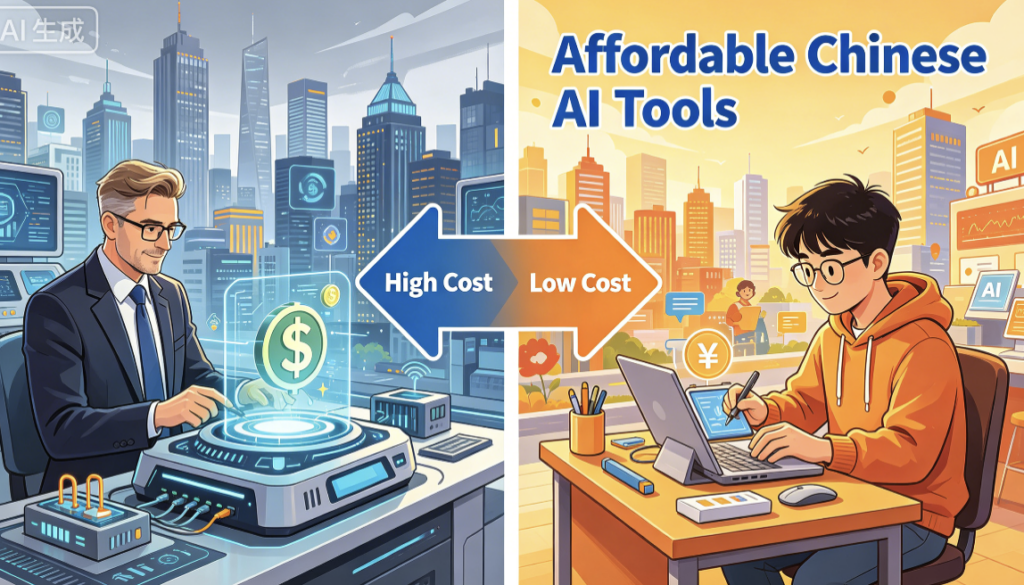
Why are those arrogant American tech giants willing to drop their pride and switch to Chinese AI silently? Today, we will skip political debates and geopolitical conflicts entirely. Let’s talk about one simple but irresistible profit calculation that every capitalist cannot ignore. Once you understand this number game, you will realize the underlying rules of global AI competition have completely changed overnight.
For a long time, the tech circle held a fixed misunderstanding: American AI represents top-tier premium technology, while Chinese AI is only a cheap alternative. However, authoritative tests released by Stanford University have broken this myth completely.
The actual performance gap between top Chinese and American AI large models is only 2.7%. For commercial business scenarios, this tiny gap means almost no practical difference at all. But when it comes to pricing, the gap is absolutely staggering.
Let’s look at the real data. Processing 1 million tokens via ChatGPT or Claude API costs between $2.5 and $25. In contrast, Chinese AI models bring costs down drastically. Alibaba Qwen only charges a little over $1, while DeepSeek and Kimi slash the price to just 15 cents per million tokens.
The overall price gap ranges from 40 times to 100 times. Let’s take a real business case for reference. If a company needs to process 100 million tokens every month, it will receive a monthly bill of $1500 when using mainstream American AI models. But switching to DeepSeek, the exact same workload with identical output quality only costs $35 per month.
If you were a Silicon Valley CEO, what choice would you make? Most entrepreneurs will publicly support local American tech on social media, yet secretly download open-source Chinese AI code late at night to cut operational costs. This is the most honest choice driven by capital interests.
Many people question: with such low pricing, are Chinese AI companies cutting corners or burning money for market share? The answer is definitely no.
Chinese AI engineers have created a unique technical advantage under huge external pressure. In past years, strict chip sanctions blocked Chinese tech teams from accessing top-tier Nvidia chips. Western tech giants once mocked that China’s AI industry would collapse without high-end hardware support.
Instead of being defeated by hardware limitations, Chinese teams reconstructed the overall internal structure of AI models relying purely on software algorithm innovation.
Take DeepSeek as a typical example. The model is split into 256 professional expert clusters. When users send a coding request, only 8 clusters will start working, while the remaining 248 clusters stay dormant. This smart design cuts the model’s running memory consumption by more than 90%.
American tech companies rely on massive expensive GPU chips to achieve AI performance through brute computing force. By comparison, Chinese AI uses delicate and optimized algorithms to achieve outstanding results with limited hardware. It only cost less than 6 million US dollars to build a world-class AI model, matching the performance of American AI products that cost hundreds of millions of dollars in research funds.
Super cost-effective efficiency has attracted massive global capital pouring into China’s AI track. The Hong Kong stock market has witnessed an AI investment boom recently. A leading Chinese AI company achieved 1160 times over-subscription during its IPO, meaning more than one thousand investors compete for one share quota. Its stock price surged 524% in just 43 trading days. Another popular AI unicorn hit 100% stock growth on its listing day, and even surpassed Baidu’s market value momentarily.
Most ordinary investors still follow outdated financial advice to buy S&P 500 index funds. Meanwhile, sharp global capital has already rushed into China’s high-growth AI market to seize dividend opportunities.
There is also a core difference between US and Chinese AI development directions. The United States regards advanced AI as a luxury high-tech product limited to laboratories. China is turning powerful AI into universal industrial tools accessible to every ordinary person.
The global short drama industry is the best proof. Previously, producing one overseas short drama cost $150,000 and took one whole month. Powered by local Chinese AI tools now, the cost drops sharply to $15,000, and the whole production can be finished within 5 days. Local governments also offer subsidies for individual AI startups. One person with several computers can run a cross-border global business easily by using nearly free open-source Chinese AI models.
This grassroots AI empowerment brings unprecedented dimensionality reduction strikes to traditional Silicon Valley enterprises.
Looking back at tech history, every time core technology changes from expensive and closed to cheap and open-source, wealth patterns will be reshaped, and new industry giants will emerge. This rule worked for the internet era and the mobile internet era, and it works perfectly for the AI era right now.
The people who earn the biggest profits are never the technology inventors, but the early adopters who master practical ways to apply new technology to real industries.
In the past, people regarded large AI models as unattainable high-end tech myths and kept paying expensive monthly subscriptions for OpenAI services. But the world has completely changed now. Top-tier AI tools including Alibaba Qwen, DeepSeek and Kimi are completely free and open for global users to download and use.
Silicon Valley elites have already mastered these cheap AI tools to boost their income secretly. If you also want to learn practical AI monetization skills and seize this rare wealth opportunity, you can follow step-by-step beginner-friendly guidance to make full use of open-source AI resources.
Grab your exclusive practical guide on Amazon now.
Affiliate Disclosure: Some links in this post are affiliate links. I may earn a small commission if you purchase through them, at no extra cost to you.