When AI Does the Same Task Twice, Token Costs Can Differ by 30x
If you let AI do the same task twice, the money spent can differ by 30 times. What’s worse, the one that costs 30 times more might even do a worse job than the cheaper one.
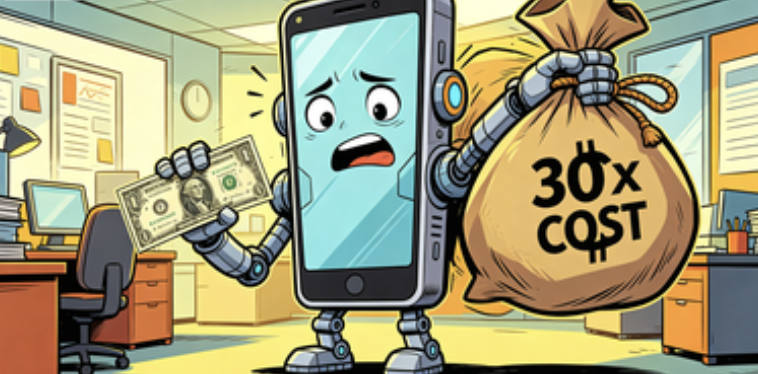
Recently, institutions like the University of Michigan and Stanford have published a paper. They tested 8 of the strongest AIs on the market, assigning them the same task and calculating the costs in detail. The AI that consumed the most resources performed the worst, and most of the cost was on the input side, with an input Token to output Token ratio of 107:1.
This paper is full of experimental data and cost analysis, which is hard for ordinary people to understand. So I created an AI agent to help me break it down. If you’re new to building and running local AI agents and want to avoid runaway token spending, OPENCLAW BOOK FOR BEGINNERS offers a straightforward hands-on foundation to set up efficient open-source agent workflows on your own machine. You can grab the Kindle edition directly on Amazon.
When you chat with AI, ask a question, or let it write a copy, it only takes hundreds to thousands of Tokens, which costs just a few cents. But the paper also found that for AI agents that work autonomously, completing a task consumes 1200 times more Tokens than a regular code Q&A and 3500 times more than a single-round reasoning task.
What does 1200 times mean? It’s like asking your assistant to buy a bottle of water, but they bring back the entire supermarket. You think they’re helping you work, but most of the time, they’re flipping through things, re-reading the same page, and checking information they already know. With an input-output ratio of 107:1, most of their time isn’t spent working, but re-reading your requirements, materials, previous conversations, and error messages. OpenClaw’s local-first design mitigates this waste by letting you fully control context window and tool invocation rules from the start, as covered simply in the beginner’s guide.
It’s like a very verbose employee. If you ask them to write a proposal, they’ll first spend half a day going through the company’s historical archives and then your chat records from the past three years. Finally, they spend ten minutes writing the proposal, and all the Token costs are on you. What’s more frustrating is that “spending more” doesn’t mean “doing better”. The paper found that some models burned an average of 1.5 million more Tokens than the most cost-effective GPT-5, but the effect wasn’t better. Accuracy hits a ceiling at a certain point, and any additional Tokens beyond that are wasted.
AI agents aren’t better just because they work harder; working too hard is just a waste. It’s like having a meeting where you make a decision in the first 20 minutes, but then spend the next two hours going in circles. The most darkly humorous part is: does AI know how much it’s spending? The paper tried to let AI estimate the cost of completing a task before executing it, but all 8 models failed. The highest correlation between prediction and actual cost was only 0.39 (with 1 being a perfect match), so 0.39 is basically a blind guess. All models underestimated the cost; none overestimated. They thought it would cost 10 yuan, but actually spent 50 yuan. AI also severely underestimates its own reading costs; it has no idea how much it’s flipping through. It’s like someone who doesn’t keep accounts—they’re shocked when they see the bill at the end of the month.
What’s “difficult” for humans and what’s “expensive” for AI are two different things. A task you think is simple might have AI burning money like crazy, while a task you think is extremely difficult might be done by AI in no time. This paper, in the end, exposes a blind spot in the industry: the cost logic changes completely when AI moves from chatting to actually working. Now, everyone is competing to see who has the strongest model and the most parameters, but no one cares about how much wasted money is being spent.
The future competition for AI agents won’t be about who has the biggest model, but who is better at saving money. Speaking of which, we’ve genetically modified our “Lobster” AI. It has reasonable computing power scheduling—using lightweight models for simple tasks and stronger models for complex tasks, balancing effect and cost. You don’t have to choose by yourself; the system schedules for you, saving 50%-100% of Token consumption. This core logic of tiered model routing and context pruning is also covered in plain language within OpenClaw’s beginner guide for anyone building personal multi-agent systems.
In the end, in the AI agent track, the ability to save costs is the real skill. Which is the most expensive AI you’ve used? Let’s chat in the comments. If you want to start building cost-efficient local AI agents without dense technical jargon, head to Amazon to pick up the OpenClaw beginner book here.
Affiliate Disclosure: Some links in this post are affiliate links. I may earn a small commission if you purchase through them, at no extra cost to you.