Many people think Tesla is just selling electric cars, but that’s a big mistake. Behind this lies Musk’s most ambitious plan, and only those who understand it will realize they might have missed an era.
A lot of people confuse electricity quantity and power. Think of electricity as water; power is the flow rate of water from a faucet. A single household using 1 kilowatt of “flow rate” is easy for the power grid to handle. But when 1,000 households use it at the same time, the flow rate becomes 1 megawatt, which is close to the energy level of a large AI satellite. If it expands to 100,000 households, that’s 100 megawatts. At this level, the power grid has to barely cope. Giants are promoting super computing clusters. 1 gigawatt is equivalent to 1 million hair dryers working at the same time. If they are turned on simultaneously, the power grid may trip instantly. However, AI demand is expanding exponentially. Chips can be upgraded generation by generation, and models can be iterated every few months, but the power grid can’t widen overnight.
AI data centers need 24-hour stable power supply. Electricity is a heavy asset. Building a conventional power plant involves a long process of site selection, approval, and grid connection. Let alone building a safe and compliant large nuclear power plant, which takes 10-15 years and is subject to numerous nuclear regulatory restrictions. Most countries’ power systems in the past were not planned for the sudden explosion of AI computing power, and their shortcomings are obvious when facing this new type of load.
But Musk’s vision is different. He believes AI will not only help you write emails, draw pictures, and chat but also make real-time judgments, reasoning, and work in fields such as logistics, scientific research, entertainment, and autonomous driving. When AI demand jumps from 1 gigawatt to 100 gigawatts, what does 100 gigawatts mean? If this system runs continuously for a year, its electricity consumption is equivalent to that of a large developed economy in a year. Humanity must add new layers to the existing power grid in the next few years, otherwise, it will really be held back.
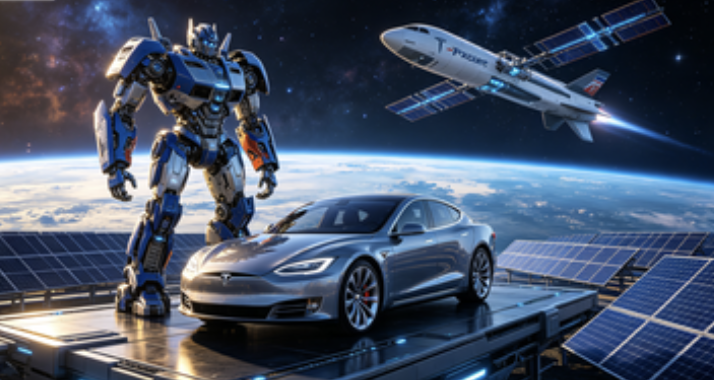
As a result, many people realize that the competition may not be about models and computing power, but about breaking away from Earth’s limitations. Musk’s SpaceX wants to launch AI satellites. These satellites are like AI mobile data centers orbiting the Earth, receiving solar radiation, driving internal AI inference chips to process massive tasks from the ground, and then sending the results back to Earth. In space, solar panels receive 40% more energy than on the ground, and their effective working time is 3-5 times that of the ground. However, supporting such satellites requires a huge area of solar panels, and issues such as satellite launch and lunar resource utilization also need to be solved. Musk wants to use his logistics system to build an industrial base on the Moon and launch AI satellites from the Moon. The idea is to directly move the most power-consuming computing process away and only transmit calculation results, because data transmission is easier than power transmission.
Tesla’s ambition doesn’t stop there. The Optimus robot is the second-generation body entering the physical world, continuing Tesla’s edge computing and industrial manufacturing capabilities accumulated in automobiles, and expanding to more complex real-world scenarios such as factories, warehouses, homes, and logistics. What Tesla sells is not just a means of transportation, but a terminal in the future machine labor network. It is constantly accumulating data, which will strengthen the entire Musk ecosystem and make it smarter.
Tesla’s first-quarter 2026 financial report revealed a key point: its revenue increased by 16% year-on-year, and its gross profit margin rose instead of falling. The number of active subscription users reached 1.28 million, and the proportion of services such as software subscriptions in the profit structure increased significantly. It is increasingly not a one-time deal. This shows that Tesla’s story has just begun.
Over the past decade or so, doubts about Tesla have never stopped. People thought electric cars had no future and that charging was difficult, but now electric cars are no longer a marginal product. New energy vehicles in China are blooming in a hundred flowers, and the Model Y has also become a global hit. Similarly, people initially doubted that SpaceX could not achieve large-scale commercialization by developing rockets privately, but now although Starship is still in progress, it has made low-cost, high-frequency, and heavy-load launches possible.
Traditional investment logic is prudent and requires certainty and comparable companies, but the most important part of Tesla is not in the financial statements. Optimus is still learning from mistakes in the factory, and space computing power, lunar industry, and physical AI are still just in their infancy. If you only measure it with the model of an automaker, you will never understand it.
Many people often misjudge Tesla because it has never been a good fit for traditional valuation models. But what really changes the world is precisely that bit of inappropriate optimism. Musk is used to putting forward extreme goals first, forcing engineering, capital, and supply chains to catch up. His timeline is not a prediction of reality, but a tool to push reality to accelerate.
The current doubts about space AI are just like the doubts about electric cars and SpaceX back then. When we look back, we will find that things that were once considered impossible are gradually becoming reality. If you still think Tesla is just an electric car company, you are wrong. Tesla’s story has just begun.