Author: trackstreamai.com

  • Tesla’s Century-Long Conspiracy: Misunderstandings and the Future

    Many people think Tesla is just selling electric cars, but that’s a big mistake. Behind this lies Musk’s most ambitious plan, and only those who understand it will realize they might have missed an era.

    A lot of people confuse electricity quantity and power. Think of electricity as water; power is the flow rate of water from a faucet. A single household using 1 kilowatt of “flow rate” is easy for the power grid to handle. But when 1,000 households use it at the same time, the flow rate becomes 1 megawatt, which is close to the energy level of a large AI satellite. If it expands to 100,000 households, that’s 100 megawatts. At this level, the power grid has to barely cope. Giants are promoting super computing clusters. 1 gigawatt is equivalent to 1 million hair dryers working at the same time. If they are turned on simultaneously, the power grid may trip instantly. However, AI demand is expanding exponentially. Chips can be upgraded generation by generation, and models can be iterated every few months, but the power grid can’t widen overnight.

    AI data centers need 24-hour stable power supply. Electricity is a heavy asset. Building a conventional power plant involves a long process of site selection, approval, and grid connection. Let alone building a safe and compliant large nuclear power plant, which takes 10-15 years and is subject to numerous nuclear regulatory restrictions. Most countries’ power systems in the past were not planned for the sudden explosion of AI computing power, and their shortcomings are obvious when facing this new type of load.

    But Musk’s vision is different. He believes AI will not only help you write emails, draw pictures, and chat but also make real-time judgments, reasoning, and work in fields such as logistics, scientific research, entertainment, and autonomous driving. When AI demand jumps from 1 gigawatt to 100 gigawatts, what does 100 gigawatts mean? If this system runs continuously for a year, its electricity consumption is equivalent to that of a large developed economy in a year. Humanity must add new layers to the existing power grid in the next few years, otherwise, it will really be held back.

    As a result, many people realize that the competition may not be about models and computing power, but about breaking away from Earth’s limitations. Musk’s SpaceX wants to launch AI satellites. These satellites are like AI mobile data centers orbiting the Earth, receiving solar radiation, driving internal AI inference chips to process massive tasks from the ground, and then sending the results back to Earth. In space, solar panels receive 40% more energy than on the ground, and their effective working time is 3-5 times that of the ground. However, supporting such satellites requires a huge area of solar panels, and issues such as satellite launch and lunar resource utilization also need to be solved. Musk wants to use his logistics system to build an industrial base on the Moon and launch AI satellites from the Moon. The idea is to directly move the most power-consuming computing process away and only transmit calculation results, because data transmission is easier than power transmission.

    Tesla’s ambition doesn’t stop there. The Optimus robot is the second-generation body entering the physical world, continuing Tesla’s edge computing and industrial manufacturing capabilities accumulated in automobiles, and expanding to more complex real-world scenarios such as factories, warehouses, homes, and logistics. What Tesla sells is not just a means of transportation, but a terminal in the future machine labor network. It is constantly accumulating data, which will strengthen the entire Musk ecosystem and make it smarter.

    Tesla’s first-quarter 2026 financial report revealed a key point: its revenue increased by 16% year-on-year, and its gross profit margin rose instead of falling. The number of active subscription users reached 1.28 million, and the proportion of services such as software subscriptions in the profit structure increased significantly. It is increasingly not a one-time deal. This shows that Tesla’s story has just begun.

    Over the past decade or so, doubts about Tesla have never stopped. People thought electric cars had no future and that charging was difficult, but now electric cars are no longer a marginal product. New energy vehicles in China are blooming in a hundred flowers, and the Model Y has also become a global hit. Similarly, people initially doubted that SpaceX could not achieve large-scale commercialization by developing rockets privately, but now although Starship is still in progress, it has made low-cost, high-frequency, and heavy-load launches possible.

    Traditional investment logic is prudent and requires certainty and comparable companies, but the most important part of Tesla is not in the financial statements. Optimus is still learning from mistakes in the factory, and space computing power, lunar industry, and physical AI are still just in their infancy. If you only measure it with the model of an automaker, you will never understand it.

    Many people often misjudge Tesla because it has never been a good fit for traditional valuation models. But what really changes the world is precisely that bit of inappropriate optimism. Musk is used to putting forward extreme goals first, forcing engineering, capital, and supply chains to catch up. His timeline is not a prediction of reality, but a tool to push reality to accelerate.

    The current doubts about space AI are just like the doubts about electric cars and SpaceX back then. When we look back, we will find that things that were once considered impossible are gradually becoming reality. If you still think Tesla is just an electric car company, you are wrong. Tesla’s story has just begun.


  • When AI Does the Same Task Twice, Token Costs Can Differ by 30x

    When AI Does the Same Task Twice, Token Costs Can Differ by 30x

    If you let AI do the same task twice, the money spent can differ by 30 times. What’s worse, the one that costs 30 times more might even do a worse job than the cheaper one.

    Recently, institutions like the University of Michigan and Stanford have published a paper. They tested 8 of the strongest AIs on the market, assigning them the same task and calculating the costs in detail. The AI that consumed the most resources performed the worst, and most of the cost was on the input side, with an input Token to output Token ratio of 107:1.

    This paper is full of experimental data and cost analysis, which is hard for ordinary people to understand. So I created an AI agent to help me break it down. If you’re new to building and running local AI agents and want to avoid runaway token spending, OPENCLAW BOOK FOR BEGINNERS offers a straightforward hands-on foundation to set up efficient open-source agent workflows on your own machine. You can grab the Kindle edition directly on Amazon.

    When you chat with AI, ask a question, or let it write a copy, it only takes hundreds to thousands of Tokens, which costs just a few cents. But the paper also found that for AI agents that work autonomously, completing a task consumes 1200 times more Tokens than a regular code Q&A and 3500 times more than a single-round reasoning task.

    What does 1200 times mean? It’s like asking your assistant to buy a bottle of water, but they bring back the entire supermarket. You think they’re helping you work, but most of the time, they’re flipping through things, re-reading the same page, and checking information they already know. With an input-output ratio of 107:1, most of their time isn’t spent working, but re-reading your requirements, materials, previous conversations, and error messages. OpenClaw’s local-first design mitigates this waste by letting you fully control context window and tool invocation rules from the start, as covered simply in the beginner’s guide.

    It’s like a very verbose employee. If you ask them to write a proposal, they’ll first spend half a day going through the company’s historical archives and then your chat records from the past three years. Finally, they spend ten minutes writing the proposal, and all the Token costs are on you. What’s more frustrating is that “spending more” doesn’t mean “doing better”. The paper found that some models burned an average of 1.5 million more Tokens than the most cost-effective GPT-5, but the effect wasn’t better. Accuracy hits a ceiling at a certain point, and any additional Tokens beyond that are wasted.

    AI agents aren’t better just because they work harder; working too hard is just a waste. It’s like having a meeting where you make a decision in the first 20 minutes, but then spend the next two hours going in circles. The most darkly humorous part is: does AI know how much it’s spending? The paper tried to let AI estimate the cost of completing a task before executing it, but all 8 models failed. The highest correlation between prediction and actual cost was only 0.39 (with 1 being a perfect match), so 0.39 is basically a blind guess. All models underestimated the cost; none overestimated. They thought it would cost 10 yuan, but actually spent 50 yuan. AI also severely underestimates its own reading costs; it has no idea how much it’s flipping through. It’s like someone who doesn’t keep accounts—they’re shocked when they see the bill at the end of the month.

    What’s “difficult” for humans and what’s “expensive” for AI are two different things. A task you think is simple might have AI burning money like crazy, while a task you think is extremely difficult might be done by AI in no time. This paper, in the end, exposes a blind spot in the industry: the cost logic changes completely when AI moves from chatting to actually working. Now, everyone is competing to see who has the strongest model and the most parameters, but no one cares about how much wasted money is being spent.

    The future competition for AI agents won’t be about who has the biggest model, but who is better at saving money. Speaking of which, we’ve genetically modified our “Lobster” AI. It has reasonable computing power scheduling—using lightweight models for simple tasks and stronger models for complex tasks, balancing effect and cost. You don’t have to choose by yourself; the system schedules for you, saving 50%-100% of Token consumption. This core logic of tiered model routing and context pruning is also covered in plain language within OpenClaw’s beginner guide for anyone building personal multi-agent systems.

    In the end, in the AI agent track, the ability to save costs is the real skill. Which is the most expensive AI you’ve used? Let’s chat in the comments. If you want to start building cost-efficient local AI agents without dense technical jargon, head to Amazon to pick up the OpenClaw beginner book here.

    Affiliate Disclosure: Some links in this post are affiliate links. I may earn a small commission if you purchase through them, at no extra cost to you.

  • Why AI Stocks Keep Surging? Full Breakdown of the 2026 AI Investment Trend

    Wondering why only AI assets are making consistent money in today’s chaotic global financial market?

    This complete breakdown covers everything you need to know about the 2026 AI investment trend, the hot AI hardware sectors driving stock rallies, and how forward-thinking executives leverage artificial intelligence to capture unmatched business growth—insights you can expand on in The AI-Driven Leader, a top-selling guide for modern decision-makers, available to purchase instantly on Amazon.

    If you’ve been tracking global markets this year, you’ve likely noticed a shocking divide. Traditional asset classes have struggled with nonstop volatility. Gold prices cool down, crypto swings wildly, and most commodity markets lack stable growth momentum. Even legendary investor Warren Buffett recorded one of his worst annual performances in history. Old-school investment logic no longer works for 2026’s shifting economic landscape.

    Against this messy backdrop, one single sector stands out with unstoppable upward momentum: artificial intelligence. All signs point to AI being the most reliable profit engine for investors in 2026, and its wealth-generating power stretches across international stock exchanges. Industry leaders who want to turn AI’s market momentum into internal competitive advantage often turn to practical frameworks outlined in bestselling leadership resources like The AI-Driven Leader.

    South Korea’s market offers a crystal-clear example. Powered by top memory chip giants Samsung and SK Hynix, the country’s benchmark index doubled within half a year. The AI hardware boom has not only lifted stock valuations but also boosted local economic vitality, proving how transformative the AI supply chain can be. Over in the US, Micron Technology’s stock skyrocketed 10X, outvaluing Berkshire Hathaway at one point. Even SoftBank’s Masayoshi Son bounced back from massive losses entirely thanks to heavy AI hardware bets.

    Many new investors make a critical mistake: they assume the AI rally revolves solely around consumer-facing chatbots, large language models or AI short dramas. That’s only surface-level hype. The real capital inflow targets three core AI hardware segments that solve critical computing bottlenecks: HBM memory chips, high-speed optical modules, and advanced PCBs. Business leaders aiming to translate this industry-wide AI boom into faster, sharper organizational decisions can pick up actionable strategies from the widely-rated book The AI-Driven Leader on Amazon, link: https://amzn.to/4a1ghie.

    First, HBM stacked memory chips. Think of a GPU as a super-fast mathematician capable of processing billions of data points per second. Without matching high-speed memory, the GPU wastes most of its power waiting for data transfers. HBM fixes this issue by vertically stacking dozens of memory layers directly next to GPUs, unlocking full computing potential. Global production capacity for premium HBM remains extremely limited, creating constant supply shortages and long-term profit growth for manufacturers.

    Second, high-speed optical modules. Massive AI server clusters rely on optical modules to transfer massive datasets between computing nodes. As tech giants expand their AI data center footprints, demand for high-performance optical hardware explodes year over year.

    Third, high-end PCBs. These specialized circuit boards act as the foundational carrier for all AI chips, engineered to withstand extreme heat and heavy continuous computing loads. Every AI server and GPU unit cannot function without premium PCBs.

    What makes these three subsectors far more attractive than generic AI software stocks? The answer lies in stable corporate earnings and massive capital expenditure commitments. Microsoft, Google and other global tech leaders have announced hundreds of billions in AI hardware spending, locking supplier orders well into future years. While fluctuating interest rates and geopolitical tensions drag down nearly every other industry’s valuation, the AI hardware chain holds unrivaled growth certainty. Executives tasked with allocating these massive AI budgets to drive tangible business outcomes will find clear, step-by-step decision-making frameworks inside the bestseller The AI-Driven Leader.

    Final Takeaways for New Investors & Business Leaders

    The 2026 AI market hype is not centered on consumer AI tools or generative chatbots. The core driving force behind surging AI stocks is the global race to build sufficient computing infrastructure. If you want to follow institutional capital flow, focus your research on three high-potential hardware verticals: HBM memory chips, high-speed optical modules, and advanced AI PCBs.

    Global market volatility will continue throughout the year, but the AI hardware supply chain retains unmatched profit potential for retail and institutional investors alike. For managers who want to turn AI’s market momentum into internal operational wins, you can grab the highly-rated guide The AI-Driven Leader directly on Amazon .

    Affiliate Disclosure: Some links in this post are affiliate links. I may earn a small commission if you purchase through them, at no extra cost to you.

  • Why Poor People Fail in Entrepreneurship? Unveil the Underlying Logic of Startup Success and Failure

    In the entrepreneurial race, the saying “poor people are doomed to fail in entrepreneurship” has never faded. Have you ever wondered why many people dive into business with great passion, only to end up putting up a “Store for Transfer” sign?

    Today, we’ll dissect the underlying logic and see how true masters use the “$100 Trial-and-Error Method” to avoid reckless financial gambles and build lasting wealth, a core mindset also highlighted in David Bach’s bestselling work Start Late, Finish Rich: A No-Fail Plan for Achieving Financial Freedom Any Age.

    1. Poor Entrepreneurs: Betting Their Entire Fortune on a Fantasy

    The typical script for an ordinary person’s entrepreneurship goes like this: They come up with a “brilliant idea”, then start to get emotionally carried away — quit their job, take out loans, rent a store, decorate it, hire staff, stock up on goods… They spend hundreds of thousands before making a single cent, and end up sitting in an empty store, lost in thought. Within two months, the cash flow dries up, and the red “Store for Transfer” notice is a testament to their shattered fantasy.

    Where do they go wrong? They don’t lose to their competitors, but to their “unverified obsession”. Take someone who wants to open a high-end fruit store in a neighborhood as an example. An ordinary person would immediately rent the store, fill the shelves with durians, cherries, blueberries, and imported oranges, make the signage as fancy as Hermès, and post 20 times a day on Moments to show off. What happens next? Three months after opening, only three old ladies come to ask for prices, and they end up eating so many cherries they’re on the verge of diabetes.

    This all-or-nothing financial gamble is exactly what wealth coaches warn against. David Bach’s Start Late, Finish Rich pushes back against this dangerous mindset, teaching readers that you don’t need to dump all your savings into one unproven venture to build long-term financial stability, no matter what stage of life you’re in.

    2. Master Entrepreneurs: Validate with $100 and Let the Market “Vote”

    A billionaire once woke me up with a sentence: “Truly successful businesspeople only spend $100 to validate a project.”

    Let’s go back to the fruit store example. Here’s how a master would do it:

    • Spend $40 on printing flyers and $60 on buying fruits for tasting;
    • Sit at the neighborhood entrance during rush hour to let people try the fruits for free;
    • Finally, just ask one question: “Would you add my WeChat if we deliver this quality of fruits to your door?”

    This single question determines whether the business is viable: if 5 out of 10 people are willing to add, the demand is real; if 100 people all shake their heads, stay away from this project — the market has already given you the answer.

    This low-cost testing framework aligns perfectly with the slow-but-steady wealth-building approach laid out in Start Late, Finish Rich. The book stresses that small, intentional checks before big investments keep you from sinking your life savings into unproven plans, even if you feel like you’re starting your money journey later than everyone else.

    3. The Fatal Flaw in Entrepreneurship: Self-Defensive Spending

    Many entrepreneurs make a common mistake: spending money out of self-gratification.

    • Buy an expensive camera before their videos go viral;
    • Rent a luxurious office before their products are sold;
    • Hire seven or eight people before getting a single customer…
      In the end, they fail in their venture but get a taste of the “loneliness of being a boss” ahead of time.

    Masters, on the other hand, are surprisingly “stingy” and clear-headed:
    When doing TikTok, they first buy two samples, shoot videos, and invest $25 in ads to test the data — Can the video reach 1,000 views? Are there any inquiries? Any sales? If yes, keep going; if no, switch immediately. Because they know that the most expensive thing in the world isn’t traffic or office space, but “silly mistakes”.

    Cutting wasteful, vanity spending is a foundational lesson from Start Late, Finish Rich. The author breaks down how unnecessary upfront costs derail both new startups and personal wealth journeys, offering simple worksheets to track and trim mindless expenses without sacrificing your quality of life.

    4. Entrepreneurship is Like DNA Testing: Don’t Invest Emotionally Before Getting Results

    The billionaire’s metaphor was quite piercing: “Poor people do business like falling in love — once they get hooked, they’re willing to give their lives. Masters do business like doing a DNA test — they never invest emotionally before getting the results.”

    Truly wealthy people are often “risk-averse”. They’d rather spend $100 to trial and error a thousand times than bet $100,000 on an uncertain future. This cautious, data-first mindset is the backbone of David Bach’s financial philosophy across all his works, including the fan-favorite audiobook Start Late, Finish Rich.

    5. A Soul-Searching Question for Entrepreneurs

    If you also want to start a business, don’t rush to quit your job, take out loans, or post on social media declaring that you’re going to “change your destiny against the odds”. First, ask yourself: Can you validate whether this business has paying customers with just $100?

    Most of the time, a lesson that can be learned with $100 is not worth paying for with half your life’s savings. Whether you’re launching a side hustle in your 30s, rebuilding finances after a failed business in your 40s, or starting wealth planning later in life, the risk-mitigation strategies we covered pair seamlessly with the actionable catch-up plan inside Start Late, Finish Rich.

    If you want a complete, step-by-step guide to rebuild your finances and build sustainable wealth at any age, Buy to Amazon

    Affiliate Disclosure: Some links in this post are affiliate links. I may earn a small commission if you purchase through them, at no extra cost to you.

  • Question-Based Compliments: The Ultimate Social Skill for Deeper Relationships & Lasting Connections

    Ever found yourself giving a generic compliment like “You’re amazing!” only to get a polite smile and zero real connection? You’re not alone. But what if there’s a social skill that lets you build genuine rapport, make people feel truly seen, and stand out in any interaction? Enter question-based compliments—the high-EQ hack that transforms how you connect with others, boost your social intelligence, and build lasting relationships.

    At its core, meaningful praise hinges on intentionality—a truth Merlin R. Carothers touches on briefly in his classic short read *Power in Praise*, where he breaks down how sincere, thoughtful praise reshapes every area of daily life. This same framework translates seamlessly to everyday casual and professional interactions: instead of delivering a one-sided judgment, frame your admiration as a curious question to center the other person.

    Why Question-Based Compliments Outshine Generic Praise

    Most people think praise is just about showering others with nice words. But here’s the truth: empty compliments (think “You’re so smart!” or “Great job!”) often feel superficial. They’re polite but forgettable.

    Question-based compliments, however, tap into a powerful psychological principle called the self-disclosure effect. Research from MIT’s cognitive labs shows that human brains crave “being truly seen” far more than “being insincerely praised”. When you ask someone a thoughtful question about their achievements, struggles, or process, their brain activates its reward, releasing dopamine (the “pleasure hormone”) as they share their story. It’s not just praise—it’s an invitation to be vulnerable, which fosters trust and deep connection.

    Let’s compare:

    • Generic Praise: “You closed that big deal! You’re awesome!” → Triggers a “being evaluated” response, making people feel guarded.
    • Question-Based Compliment: “How did you navigate that tricky client negotiation? I’d love to learn from your approach!” → Triggers excitement, as they feel “truly seen” and eager to open up.

    4 Proven Question-Based Compliment Templates for Any Situation

    Ready to put this into action? Here are four fail-safe templates that work in professional, social, and personal settings:

    1. The “Achievement Process” Question

    Instead of just celebrating the win, ask about the journey.
    Example: “You delivered that presentation flawlessly! Walk me through how you prepped—were there any moments you felt stuck, and how did you overcome them?”

    2. The “Detail-Oriented” Question

    Notice a specific detail and ask about it—this shows you’re actually paying attention.
    Example: “Your report’s data visualization is so clear! How did you decide on that format, and what tools did you use to make it so impactful?”

    3. The “Decision-Making” Question

    When someone makes a bold choice, ask about their thought process.
    Example: “You took a huge leap by launching that side project! What pros and cons did you weigh before committing, and what made you finally take the plunge?”

    4. The “Struggle & Growth” Question

    People want their hard work (not just their success) to be acknowledged.
    Example: “Your team’s resilience through that company restructuring is impressive. What was the toughest challenge you faced, and how did you keep morale high?”

    Actionable Steps to Master Question-Based Compliments Today

    Want to make this a habit? Follow these two simple steps:

    Step 1: Practice “Intentional Observation”

    Pick one key person in your network (a colleague, friend, or client). Jot down one specific detail about something they’ve done recently (e.g., “Jane redesigned the website’s checkout flow” or “Mike led a successful workshop on time management”). This shifts you from “passive interaction” to “active noticing”—a cornerstone of genuine connection.

    Step 2: Reframe Your Praise Into a Question

    Use this formula: “[Specific Observation]—how did you [achieve/decide/overcome] that? I’m fascinated by your approach.”
    Example: “I noticed how you handled that difficult team feedback with such empathy—how did you build that skill? I’d love to grow in that area too.”

    Final Thought: Social Skill Isn’t About Being “Smooth”—It’s About Being “Present”

    Question-based compliments aren’t a trick—they’re a mark of high emotional intelligence (EQ). They show you care about people, not just impressing them. By asking thoughtful questions, you’re not just building relationships—you’re creating a space where others feel valued, heard, and eager to connect with you.

    So next time you’re tempted to say “Great job!”, pause. Ask a question instead. You’ll be shocked at how quickly conversations deepen, trust grows, and your social circle becomes more meaningful.

    If you want to dive deeper into foundational perspectives on the transformative power of praise, grab your copy of Power in Praise on Amazon

    Affiliate Disclosure: Some links in this post are affiliate links. I may earn a small commission if you purchase through them, at no extra cost to you.

  • Why Some Earn $300 a Day and Others $30,000?

    Ever wondered how two people selling identical apples end up with night-and-day results—one scraping by on $300 per day, the other pulling in $30,000 daily? The massive gap isn’t driven by how hard each person works. The decisive factor is simple: whether you operate from a structured, mature business model.

    Lots of small business owners mistake themselves for bosses, when really they’re just trading their time for money like a regular employee. Think of a street apple vendor with zero defined audience—sales swing wildly based on luck. Bad weather or undercutting rivals tank earnings instantly. These operations rely on a single revenue stream with zero reliable growth trajectory. As supply, labor and material costs climb nonstop, risk piles higher each month. A business without consistent growth is slowly losing ground, no matter how much cash it seems to bring in short term.

    Any enterprise built to last and scale effortlessly hinges on a clear business framework. Three foundational models apply across every industry, and mastering their logic lets you turn a fleeting side hustle into a sustainable long-term venture.

    1. Supplier Model

    The most ubiquitous framework, built entirely on profit from product margins. Entrepreneurs execute this in multiple ways: securing orchard supply to wholesale B2B to grocery stores and supermarkets; building proprietary brands with corporate locations and franchise partners to create a full B2B2C pipeline from producer to end buyer; or curating specialized packaging for niche demographics and driving targeted sales through private community channels. The biggest upside here is a clearly identifiable target audience, stabilizing revenue, with profits anchored to your supply chain and physical products.

    2. Service Provider Model

    This approach demands a total mental shift. You stop viewing your goods as isolated items to sell, and instead treat them as a bridge to connect with a specific audience. Instead of one-off transactions, you wrap your products into holistic ongoing services. For the apple example, this could mean curating premium seasonal fruit into an annual membership subscription, earning recurring revenue from membership fees and service markups.

    Your most valuable asset here is not inventory—it’s a loyal, trusting cohort of high-value customers. Recurring memberships generate steady, healthy cash flow, and your per-customer operational costs shrink as your member base expands, unlocking massive room to scale.

    3. Platform Model

    This is a more advanced entrepreneurial strategy. Rather than manufacturing or selling goods yourself, you build a digital or physical marketplace linking producers and shoppers, generating income via commission and service fees. The biggest advantage is zero exposure to production, inventory, and retail sales risk—all while you control traffic, consumer data and market influence, granting you outsized industry leverage with nearly unlimited profit potential.

    No single business model ranks as superior; the right choice depends entirely on your unique resources, goals and constraints. Test whether your project is a temporary gig or viable lasting business by answering three critical questions:

    1. Is your ideal customer audience sharply defined?
    2. Do you have diverse revenue streams with clear room to expand?
    3. Does your marginal cost drop as your operation grows larger?

    At the end of the day, income limited solely by manual labor and time will always hit a ceiling. Businesses built on repeatable systems, brand equity, loyal audiences and actionable data can evolve indefinitely. If you’re running your own venture, pause to audit your current setup and adopt a framework that makes every hour of hard work count exponentially more.

    It’s easy to grasp these three high-level business model categories in theory, yet many founders struggle to map this logic to their own real-world operations, design customized models, or renovate outdated existing workflows.

    For a practical, industry-standard framework to turn these theories into actionable plans, I rely on Business Model Generation: A Handbook for Visionaries, Game Changers, and Challengers. Created by Alexander Osterwalder and Yves Pigneur, this book introduced the famous Business Model Canvas, a visual tool adopted by global brands including 3M, Ericsson and Deloitte. It walks you through auditing every core segment of your business: customers, channels, partnerships, revenue streams, cost structures, and your unique value proposition.

    If you want a hands-on guide to design or rebuild your own viable business model, you can pick up a copy directly on Amazon here

    Affiliate Disclosure: Some links in this post are affiliate links. I may earn a small commission if you purchase through them, at no extra cost to you.

  • Silicon Valley’s Dirty Secret: Why 80% of Startups Secretly Use Chinese AI

    Silicon Valley’s Dirty Secret: Why 80% of Startups Secretly Use Chinese AI Behind Closed Doors

    Would you believe it? The most downloaded AI large model across the globe is neither ChatGPT nor Google Gemini. Surprisingly, this top-ranking AI tool comes from an underrated Chinese tech brand that rarely makes mainstream tech headlines.

    Right now, behind the public calls for tech decoupling in Silicon Valley, a shocking truth is happening quietly. A full 80% of American startups are secretly migrating their core business systems to Chinese AI models.

    Airbnb uses Chinese AI to run its customer service system smoothly. Pinterest relies on these affordable AI tools to rebuild its entire content recommendation algorithm. Even Cursor, the most popular AI coding tool sweeping the United States, shocked tech geeks recently. After digging into its underlying code, experts confirmed its core AI engine is developed by a tech startup based in Beijing.

    Why are those arrogant American tech giants willing to drop their pride and switch to Chinese AI silently? Today, we will skip political debates and geopolitical conflicts entirely. Let’s talk about one simple but irresistible profit calculation that every capitalist cannot ignore. Once you understand this number game, you will realize the underlying rules of global AI competition have completely changed overnight.

    For a long time, the tech circle held a fixed misunderstanding: American AI represents top-tier premium technology, while Chinese AI is only a cheap alternative. However, authoritative tests released by Stanford University have broken this myth completely.

    The actual performance gap between top Chinese and American AI large models is only 2.7%. For commercial business scenarios, this tiny gap means almost no practical difference at all. But when it comes to pricing, the gap is absolutely staggering.

    Let’s look at the real data. Processing 1 million tokens via ChatGPT or Claude API costs between $2.5 and $25. In contrast, Chinese AI models bring costs down drastically. Alibaba Qwen only charges a little over $1, while DeepSeek and Kimi slash the price to just 15 cents per million tokens.

    The overall price gap ranges from 40 times to 100 times. Let’s take a real business case for reference. If a company needs to process 100 million tokens every month, it will receive a monthly bill of $1500 when using mainstream American AI models. But switching to DeepSeek, the exact same workload with identical output quality only costs $35 per month.

    If you were a Silicon Valley CEO, what choice would you make? Most entrepreneurs will publicly support local American tech on social media, yet secretly download open-source Chinese AI code late at night to cut operational costs. This is the most honest choice driven by capital interests.

    Many people question: with such low pricing, are Chinese AI companies cutting corners or burning money for market share? The answer is definitely no.

    Chinese AI engineers have created a unique technical advantage under huge external pressure. In past years, strict chip sanctions blocked Chinese tech teams from accessing top-tier Nvidia chips. Western tech giants once mocked that China’s AI industry would collapse without high-end hardware support.

    Instead of being defeated by hardware limitations, Chinese teams reconstructed the overall internal structure of AI models relying purely on software algorithm innovation.

    Take DeepSeek as a typical example. The model is split into 256 professional expert clusters. When users send a coding request, only 8 clusters will start working, while the remaining 248 clusters stay dormant. This smart design cuts the model’s running memory consumption by more than 90%.

    American tech companies rely on massive expensive GPU chips to achieve AI performance through brute computing force. By comparison, Chinese AI uses delicate and optimized algorithms to achieve outstanding results with limited hardware. It only cost less than 6 million US dollars to build a world-class AI model, matching the performance of American AI products that cost hundreds of millions of dollars in research funds.

    Super cost-effective efficiency has attracted massive global capital pouring into China’s AI track. The Hong Kong stock market has witnessed an AI investment boom recently. A leading Chinese AI company achieved 1160 times over-subscription during its IPO, meaning more than one thousand investors compete for one share quota. Its stock price surged 524% in just 43 trading days. Another popular AI unicorn hit 100% stock growth on its listing day, and even surpassed Baidu’s market value momentarily.

    Most ordinary investors still follow outdated financial advice to buy S&P 500 index funds. Meanwhile, sharp global capital has already rushed into China’s high-growth AI market to seize dividend opportunities.

    There is also a core difference between US and Chinese AI development directions. The United States regards advanced AI as a luxury high-tech product limited to laboratories. China is turning powerful AI into universal industrial tools accessible to every ordinary person.

    The global short drama industry is the best proof. Previously, producing one overseas short drama cost $150,000 and took one whole month. Powered by local Chinese AI tools now, the cost drops sharply to $15,000, and the whole production can be finished within 5 days. Local governments also offer subsidies for individual AI startups. One person with several computers can run a cross-border global business easily by using nearly free open-source Chinese AI models.

    This grassroots AI empowerment brings unprecedented dimensionality reduction strikes to traditional Silicon Valley enterprises.

    Looking back at tech history, every time core technology changes from expensive and closed to cheap and open-source, wealth patterns will be reshaped, and new industry giants will emerge. This rule worked for the internet era and the mobile internet era, and it works perfectly for the AI era right now.

    The people who earn the biggest profits are never the technology inventors, but the early adopters who master practical ways to apply new technology to real industries.

    In the past, people regarded large AI models as unattainable high-end tech myths and kept paying expensive monthly subscriptions for OpenAI services. But the world has completely changed now. Top-tier AI tools including Alibaba Qwen, DeepSeek and Kimi are completely free and open for global users to download and use.

    Silicon Valley elites have already mastered these cheap AI tools to boost their income secretly. If you also want to learn practical AI monetization skills and seize this rare wealth opportunity, you can follow step-by-step beginner-friendly guidance to make full use of open-source AI resources.

    Grab your exclusive practical guide on Amazon now.

    Affiliate Disclosure: Some links in this post are affiliate links. I may earn a small commission if you purchase through them, at no extra cost to you.

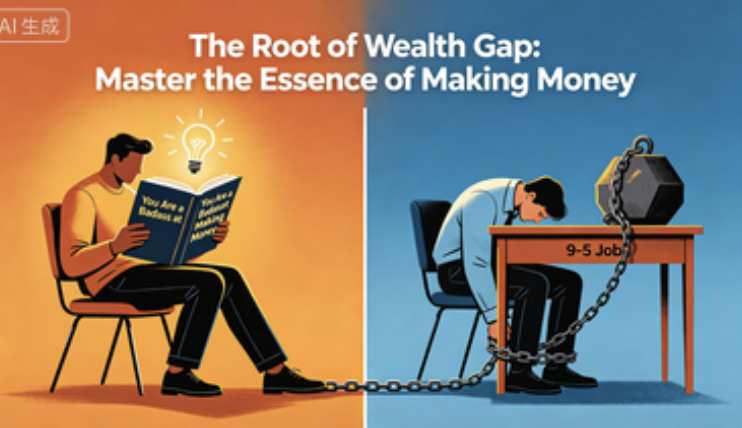
  • The Root of Wealth Gap: Master the Essence of Making Money & Upgrade Your Business Cognition

    The Root of Wealth Gap: Master the Essence of Making Money & Upgrade Your Business Cognition

    Ever wondered why so many people stay trapped living paycheck to paycheck, while others steadily build lasting wealth? The divide boils down to one simple thing: your core mindset around money, and whether you grasp the true essence of how wealth is created.

    1. We’re Taught the Wrong Financial Blueprint From Childhood

    From grade school onward, society drills a rigid script into us: study hard, ace exams, land a stable full-time job. This framework worked well for the industrial era, but it only builds job skills—not wealth logic.

    Most parents and teachers live by trading time for wages, so their worldview can’t teach you how money multiplies independently of your hours. If you only chase formal credentials, you’ll likely become a high-tier employee, never escape the trading-time-for-income loop.

    Working a traditional job is risk mitigation: you hand over entrepreneurial risk to your employer, who keeps the majority of surplus profit and only covers your basic living costs. To move past this ceiling, you have to unlearn old programming and rebuild your wealth mindset. I’ve found the book You Are a Badass at Making Money incredibly helpful for untangling limiting money beliefs and rewiring your brain for abundance.

    2. True Profit Relies on Gaps, Not Hard Labor or Degrees

    Money doesn’t reward brute effort or fancy diplomas alone. Real profit comes from three critical asymmetries:

    • Cognition gaps: Insights others haven’t yet learned
    • Information gaps: Access to trends, resources, or opportunities hidden from the masses
    • Resource integration: Connecting separate pieces to create new value

    Most people struggle financially because they fixate on “how do I get paid?” instead of “what pain or problem can I solve for others?” At its simplest, making money is pure value exchange. The larger the audience you serve and the bigger the problem you resolve, the greater your earning potential:

    • Helping a neighbor run errands earns modest side cash
    • Running a neighborhood store builds recurring system-based income
    • Building a nationwide service platform unlocks scalable capital-level gains

    When your material wealth outpaces your mental framework, the market will always pull your finances back down to match your mindset. This is why two people can encounter the exact same business opening—one sees a goldmine, the other sees meaningless noise.

    3. Leverage Is How You Escape Time Limitations

    Your time is finite; every person only gets 24 hours daily. You cannot build extraordinary wealth solely by selling hours of your life. The fix is leveraging multipliers to scale your impact:

    1. Human leverage: Build teams of talented people who generate output for you
    2. Capital leverage: Let invested assets grow passively while you rest
    3. Tech leverage: Create digital products, code, or content that sells infinitely after one creation effort
    4. Media leverage: Publish articles, videos, and content online to reach thousands or millions of people globally

    Today’s internet is the most accessible leverage tool for regular people. No elite connections or family fortune required—clear, valuable ideas let you reach audiences worldwide instantly. Reframing your internal narrative around earning power makes this shift far less intimidating, which is where mindset-focused resources like You Are a Badass at Making Money shine.

    4. Practical Ways to Study Wealth Without Risky Bets

    If you’re ready to deepen your business cognition and decode how money functions in the real world, start small with low-stakes habits:

    • Observe everyday life: Note crowded retail spaces, viral online topics, and unpack how each turns a profit
    • Spend time around growth-minded, financially successful people—absorb their decision-making process and thought patterns
    • Test tiny business concepts with minimal upfront cost; treat missteps as education, and scale ideas that prove effective

    5. Poverty Is a Generational Cycle Only You Can Break

    A harsh truth: limited financial thinking passes down through families by default. If you never rewrite your money mindset, your children will repeat the same loop: grind through school, work a 9–5 to cover bills, and pass the same limited beliefs to their own kids.

    Talking about money is never shallow—it’s the foundation of autonomy. Financial freedom lets you secure top-tier care for aging family, give your kids expansive life experiences, and walk away from obligations you hate.

    Start your transformation today: cut empty mindless scrolling and unproductive busywork. Prioritize learning business fundamentals, human behavior, and the art of value exchange. This shift in focus is the fastest path to personal growth and financial independence.

    If you want to dive deeper into overhauling your wealth mindset, head to Amazon to grab your copy of You Are a Badass at Making Money.

    Affiliate Disclosure: Some links in this post are affiliate links. I may earn a small commission if you purchase through them, at no extra cost to you.

  • The Festinger Law: What True Emotional Freedom Really Looks Like

    The Festinger Law can help you achieve remarkable emotional stability.

    What most people call “letting go” is merely an illusion. Here is what genuine emotional freedom truly means.

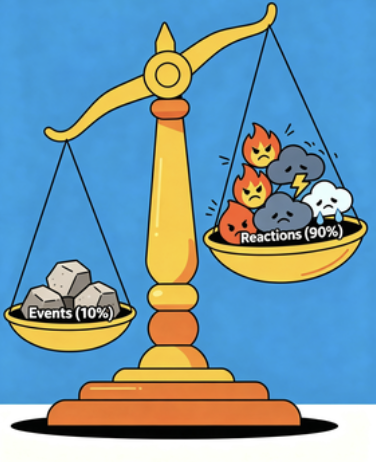
    Leon Festinger, a renowned American social psychologist, put forward this famous law: 10% of life is made up of what happens to you, while the remaining 90% depends on how you react to those events. This principle completely reshaped my understanding of emotion management. It reveals a harsh truth: it is never the incident itself that breaks you, but your reaction to it.

    Many people mistake emotional stability for holding back feelings, suppressing emotions or forcing themselves to “look on the bright side”. That is fake peace of mind, nothing but self-deception. True emotional freedom does not mean having no emotions at all. Instead, you can clearly recognize how emotions arise, and then consciously choose how to respond. This is the core of the Festinger Law — it’s not about controlling your emotions, but controlling your reactions.

    Why do we always get held hostage by our emotions? Because we confuse the 10% of events with the 90% of our reactions. Someone cuts in line ahead of you in the morning, and you stay furious the whole day. It is not the queue-jumping that ruins your mood, but your choice to stay angry. When your supervisor criticizes you, you feel wronged and furious, and even lose sleep at night. It is not the criticism itself that keeps you awake, but replaying the moment over and over in your head and amplifying negative feelings.

    I’ve seen countless people trapped in a vicious cycle of emotional breakdowns.
    The first type is the chain reaction: A trivial matter stirs up negative emotions, which then affects everything you do next, turning your whole day into a mess.
    The second is rumination: Long after things are over, you keep dwelling on the past and imagining what could have been, letting a single hurt linger on endlessly.
    The third is displaced anger: You take out your frustrations on innocent people around you, damaging relationships and creating more troubles.

    I’ve been through all three patterns. Some time last year, I was in a terrible state when a business partner suddenly broke the contract. I flew into a rage, feeling cheated and insulted. Carrying this bad mood, I spoke sharply to my team and treated my family coldly. Lying in bed at night, I couldn’t stop thinking about what had happened. The anger kept me awake until 3 a.m. The next day, exhausted and unfocused, I messed up an important meeting.

    The broken contract was only that 10% event, yet my reactions turned it into a full-blown disaster that took up the other 90% of my life. Then I started to practice the Festinger Law deliberately. I made a rule for myself: Whenever something upsets me, I pause for three seconds and ask myself three questions:

    1. How serious is this matter really?
    2. Will my current reaction make things better or worse?
    3. Will I still care about this a year from now?

    Festinger’s lifelong research into human thought and behavior laid the groundwork for this transformative rule, most notably outlined in his foundational work A Theory of Cognitive Dissonance. If you want to dive deeper into his core psychological frameworks, you can pick up a copy on Amazon.

    These three questions act like a filter, separating the 10% of events from the 90% of reactions. Three months later, I became far more emotionally stable, even surprising myself. When another partner backed out later on, I paused for three seconds. I realized setbacks like this are just part of business. My anger would change nothing and only cloud my judgment for finding new partners. So I chose to stay calm and immediately worked on alternative plans. Within two days, I secured an even better cooperation deal.

    The results speak for themselves. Before practicing this law, I lost sleep 3 to 4 times a week due to mood swings, and my work efficiency dropped to 60% of normal. Conflicts with people around me happened 2 to 3 times every week. After practicing, my work efficiency bounced back to over 90%, and interpersonal conflicts almost disappeared. Most importantly, I gained true emotional freedom. Troubles still come, but I no longer get stuck in emotional turmoil — I know exactly how to deal with them.

    So what does true emotional freedom look like? It means you accept that you cannot control what happens externally, but you hold full control over your responses. It means you notice your emotions the moment they surface, and decide whether to let them take over. You stop wasting time and energy on pointless reactions, and focus all your efforts on solving the actual problem at hand.

    From today on, pause for three seconds whenever your mood wavers, and ask yourself those three questions. Never let your reactions ruin your life again. Remember: events only account for 10%, and your reactions shape the other 90%. Once you truly master this principle, you will understand that emotional stability is not just a skill — it is a choice. Control your reactions, and you take charge of your life.


    Affiliate Disclosure: Some links in this post are affiliate links. I may earn a small commission if you purchase through them, at no extra cost to you.

  • Wrong Speaking Order Ruins Relationships: Empathy-First Communication Tips That Work


    Have you ever wondered why you say the right words, but people still get defensive, upset or refuse to listen to you? I used to struggle with bad conversations all the time, until I figured out one simple truth: poor speaking order is the top cause of failed communication and broken relationships. Mastering empathy first communication is not about being more persuasive—it is about changing the sequence of every sentence you speak.

    My Real Experience: How Wrong Speaking Order Damaged My Close Relationship

    A few months ago, I had a terrible conflict with my closest best friend because of my bad conversation habits, and it left us cold for nearly two weeks.

    My friend missed our planned weekend trip without advance notice, and I lost my temper immediately. I opened our chat directly with a harsh conclusion: You are so irresponsible, and you made me feel really disappointed.

    As soon as I sent this sentence, her defense mechanism kicked in right away. Instead of reflecting on her mistake, she started arguing back, feeling I was blaming her unilaterally and ignoring her emergency situation. We had a fierce quarrel overnight, neither of us wanted to compromise, and our friendship fell into a deadlock.

    At that moment, I realized I made the most common communication mistake: leading with judgment instead of empathy. Almost all ordinary people follow this wrong talking sequence: Direct Conclusion → Reasons → Ignore others’ feelings.

    No matter how reasonable your follow-up explanations are, listeners will shut down their listening mode once they hear direct criticism. They only focus on defending themselves, which makes all your words useless. This is why even sincere talks end up in conflicts.

    Why Most Conversations Fail: The Broken Speaking Sequence Everyone Uses

    Whether you talk with colleagues, leaders, friends or family members, people always use the wrong speaking order unconsciously. Here are three typical daily scenarios that trigger defensive communication easily:

    • Giving work suggestions to leaders: Opening with “This project plan has obvious flaws and needs revision”. Leaders will think you are denying their previous work and reject your suggestions directly.
    • Expressing dissatisfaction to friends: Opening with blame and disappointment. Friends will feel accused and choose to fight back rather than understand your true feelings.
    • Promoting ideas to clients: Opening with product advantages directly. Clients will generate instant alertness and refuse to accept your follow-up content.

    All these communication failures are not caused by wrong content, but wrong speaking order. Human beings always feel emotions before thinking logically. If you go against this human nature, you will always fail in conversations.

    The Correct 4-Step Speaking Order: Empathy → Context → Conclusion → Reason

    After learning this practical communication framework, I took the initiative to reconcile with my friend, and our relationship recovered quickly. This empathy-first speaking sequence works for all daily tough talks, helping you avoid defensive communication completely.

    Step 1: Empathize first (calm down others’ emotions)

    Recognize and understand the other person’s situation first, instead of giving criticism at the beginning. I said to my friend: I know you suddenly missed our trip because you encountered an unexpected emergency, and you must have been very stressed these days.

    Step 2: State objective context (describe facts without blame)

    Talk about what happened objectively, without subjective accusations. But this sudden change made me arrange all my plans in vain, and I felt confused and upset for a long time.

    Step 3: Put forward gentle conclusion (express your true need)

    State your idea softly instead of tough judgment. I hope we can inform each other in advance next time if anything unexpected happens.

    Step 4: Supplement detailed reasons (make your words convincing)

    Explain your inner thoughts to make the conversation more sincere. I value our friendship very much, so I don’t want similar misunderstandings to happen again.

    After adjusting my speaking order, my friend immediately let go of her negative emotions. She understood my feelings and sincerely apologized to me. A fierce conflict was solved easily, only by changing the order of sentences.

    3 Instantly Replaceable Daily Sentences for Better Communication

    Here are 3 simple sentence replacements you can use right now to optimize your daily talks, no complicated skills needed:

    1. Replace “You are wrong” with: I totally understand your perspective, but I have another idea to share with you.
    2. Replace “You should do this” with: If I were you, I might try another method, you can check whether it fits your situation.
    3. Replace “You need to correct this mistake” with: Small adjustments on this matter will bring better results, I want to share my opinions with you.

    The core point is simple: move all your subjective judgments to the end of the conversation, and leave the beginning for empathy and mutual understanding.

    Deepen Your Communication Skills: Must-Buy Communication Book on Amazon

    If you want to further improve your conversation skills, solve long-term relationship conflicts and handle all high-stakes talks smoothly, I highly recommend this top-rated communication book available on Amazon: Crucial Conversations: Tools for Talking When Stakes Are High.

    This book is a long-term Amazon bestseller in interpersonal communication, with over 4.7 stars average rating and hundreds of thousands of real reader reviews. It perfectly expands the empathy first communication method we talked about today, covering targeted communication solutions for workplace disputes, family contradictions, friend conflicts and awkward daily conversations.

    Different from empty communication theories, this book provides step-by-step operable speaking frameworks, helping you stay calm during emotional talks, eliminate others’ defensiveness quickly, and build long-term trust in all relationships.

    Buy Reminder: You can search and purchase this practical communication book directly on Amazon. I will attach my exclusive Amazon affiliate link below this article for one-click access, helping you get this must-read interpersonal skill book conveniently.

    Go to Amazon to check

    Final Thoughts

    Good communication never requires you to be eloquent or smooth-talking. The biggest gap between people who are good at talking and ordinary people is justspeaking order. Always deal with people’s emotions first, then deal with specific things.

    Start adjusting your speaking sequence today, practice empathy first communication in every conversation, and you will find all relationship conflicts and awkward talks can be solved easily.

    Affiliate Disclosure: Some links in this post are affiliate links. I may earn a small commission if you purchase through them, at no extra cost to you.